
 My Melodrama

 Catch while you still can
Turandot: Problematic Fave
Problematic fave Franco Zeffirelli’s production of Turandot has been in repertory at the Met Opera on and off for nearly four decades, well after most of the Western world in theatre, cinema, and other arts had decided that race play — both literally and in a broader aesthetic sense — was gauche. Springing partly from a melody Puccini found in a music box from the late 19th century, according to the New York Times’ Zachary Woolfe, Giacomo Puccini’s Turandot premiered in Italy at La Scala in Milan in 1926, its score completed posthumously by Franco Alfano. The show transports the fairy tale of a strong-willed princess and the treacherous tasks she sends her suitor to complete, codified in Carlo Gozzi’s 18th century play of the same name, borrowed from an allegedly Persian myth (found in Les Mille et un jours) and subsequently adapted by Frederich Schiller in 1801 (which served as Puccini’s jumping off point). So: from the world of Commedia dell’arte to the Romantic style, and from Italy to a (very) imaginary Peking. While all other suitors have failed, leading to the Princess’s demands for their execution, Prince Calaf’s love for Princess Turandot transcends the many challenges before him: her iciness and guillotine-happy glare, her three tests for him, and the bloodlust of the crowd. True as ever, audiences love a bit of danger.
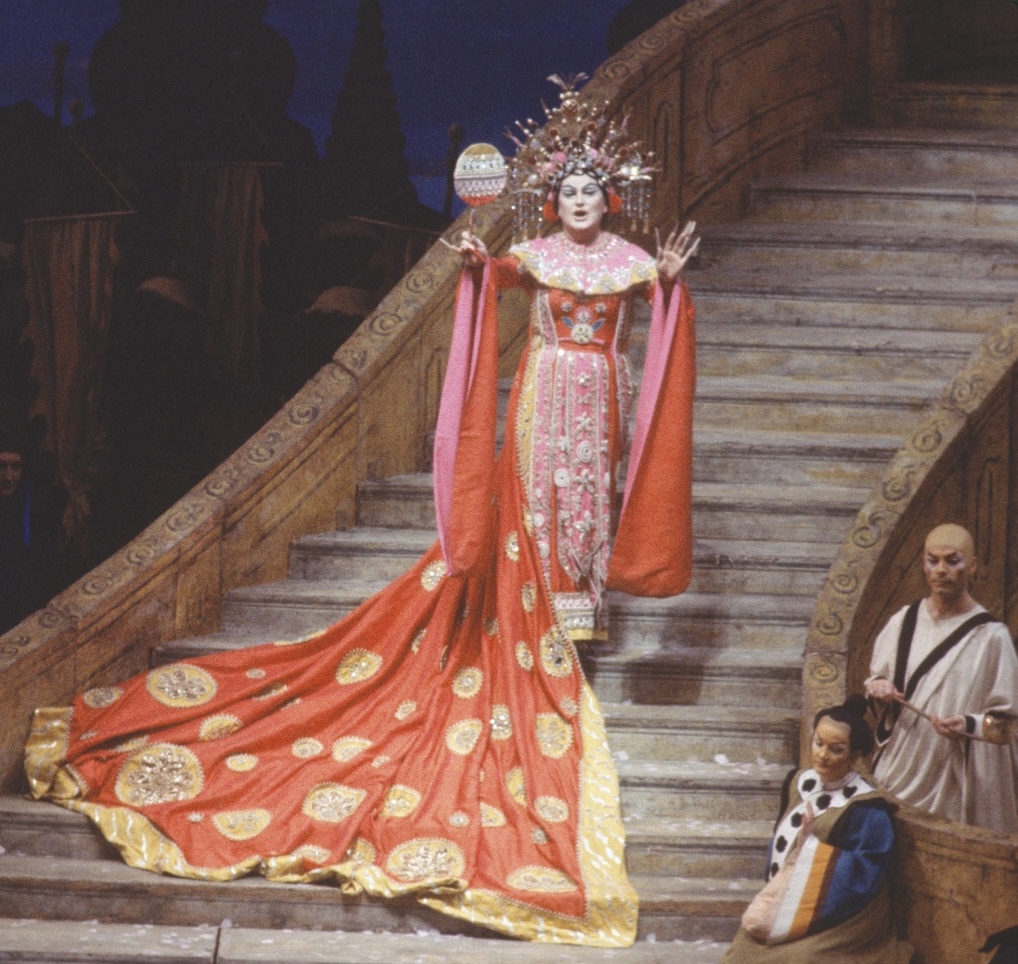
The opera world is not like the rest of the world, and every few years some opera company invites scrutiny for its dedication to tradition and disinterest in leveling the playing field. Where some theatre companies are enthusiastically overcorrecting for their history of inequity and/or racism (to the extent that it becomes crass commodification), the opera landscape (of which I confess an at best cursory relationship to, outside of writing research) has managed to cling to its old-fashionedness.
What’s it like to see the production in 2025, particularly in the midst of an influx of art that leans on a kind of Asian diaspora blues narrative where parents can’t say “I love you” and second, third, and fourth generations of Chinese (and other people of Asian descent) wring their hands over the guilt they feel over their ancestors’ sacrifice, from Everything Everywhere All at Once to Did You Eat? (밥 먹었니?) at the Public Theater? Turandot is nothing if not a thrill ride and a singular lofty attempt at exploding Chinoiserie into aesthetic virtuosity. The production, whose design and visual feast, is connected to the music in its sheer delirium: sparkling gold beads, gorgeous sequined gowns, monumental stage craft. It is so clearly fantasy and imagination, on such a ludicrous scale, it’s hard to resent its obvious racial and cultural ignorance.
There’s occasionally the assumption smuggled into rhetoric that at once proclaims that Asians, like any other underrepresented group, are not a monolith and yet expects out of them collective disdain for such examples as a Turandot or a Madama Butterfly or even, on the flip side, a uniform support for Crazy Rich Asians (which I like!) or the aforementioned Best Picture winning Everything Everywhere. Though these do not necessarily shame the same audience, they may nonetheless get lumped together. Without devolving into self-serving auto-criticism, my favorite position when approaching any of these kinds of works that foreground, aesthetically or in its register, Asianness is indifference with a sprinkling of skepticism. The controversial and, frankly, retrograde is more exciting to me as a critic precisely because they require more of me as an audience member: can one see, through its forestry of ungenerous stereotypes and racial artificiality, some kind of core human experience? Is it worth pushing through the canopies of gross offense and shiny white indulgence to find some kind of ecstasy or transcendence that all art, regardless of maker, is supposed to offer, when its systematic toll continues to loom large even in the 21st century?
In 2014, Andrew Bolton made his attempt at trying to isolate Orientalist aesthetics in a very “art for art’s sake” manner with his Met Costume Exhibit “China: Through the Looking Glass”, an optimistic and somewhat naive enterprise documented in the film The First Monday in May. He played defense even as other Met Museum employees and consultants, such as Wong Kar-wai and heads of the Chinese and East Asian art departments, warned Bolton about what was going to happen if he tried to depoliticize art that was inherently the product of politics in action.
 “China: Through the Looking Glass”, Lacy Kiernan
My first Turandot (a great name for a children’s book, if I do say so myself) was in early October, and I went with a friend who is an opera singer and cabaret performer, and much better informed in the history of the form than I am. (For the sake of disclosure, yes, my friend is white. But I still love him! Shout out to Daniel Illig) The thought of seeing something so outdated that has all the same persisted as one of the Met’s most famous productions was too alluring. And merely on the merits of its production design, costume, and scale, Turandot is a frenzied feast for the eye. Towering roofs, glittering robes (that wittily blend ‘70s Halston-esque silhouettes and pastel colors, and backdrops that foreground the show’s derangedly fanciful depiction of non-specific (Imperial?) Chinese past. In its current form, it is style as substance; the incomplete score (completed after Puccini’s death in 1924 by Franco Alfano) has moments of sonic reverie but tends to work on the impulses of clanging every gong and blowing each piccolo for almost parodically midwestern Chinese restaurant muzak. Puccini’s score never really finds a way to embody to push and pull, or the domination and feeling of surrender the Prince and Princess experience. The sense of submission, pain, and arduousness of love is strangely better embodied by its bizarre visual grammar, of charcoal blues and dusty greys that turn to glimmering golds, sundrenched reds, and pearly whites.
 Turandot, Royal Opera House, 2017, Photograph by Tristram Kenton
To praise uncritically the feverdream on display in Turandot would run the risk of skipping down a similar path to Bolton. Obviously, Turandot‘s legacy, textually and in its conception by Giacomo Puccini in the mid 1920s, is inextricable from his attitudes about Asia as well as Europe’s (and the West’s) more generally. And artists like Ai Weiwei and Zhang Yimou have each attempted to remake Turandot to contend with the realities of Imperial and Contemporary China, to fix the feature of a buggy program. Obviously, the ideal is, of course, racial (and gender and class) equity in the arts, and that there can be many Turandots and even more new work that gets to be in dialogue with the original.
But the tension between Puccini/Italy/Europe/early America’s fantasy of the East (from the 1920s/80s no less) and how the western theatre world has decided to contend with art and culture about East Asia is exactly what makes the production so fascinating. Its thorniness is its naughty appeal. It is almost completely removed from any reality (Ping, Pang, and Pong? Come on!), its mythic scale a hodgepodge of vaguely Eastern elements drowned in glitter and gaudiness, but there’s a perverse pleasure in succumbing to the sensory assault. In a culture that ping pongs aggressively between “woke is dead” and “woke is so back”, it is exactly in that space between the political grotesqueness of such a production, still going strong for nearly 40 years, and its undeniable mastery of craft and talent, of flamboyant artistic abandon, that Turandot sits on its throne, like a queen of un-PC opera. Not so much looking forward or backwards, but maybe in the direction where nirvana could be.
Share a commentWe’d love to hear your thoughts
You must be logged in to post a comment.